Hello my name is Pui, I am a web developer based in London.
Evolution of the Web Medium: Content Communication at its Best
29 January 2013
A while back I wrote about How Genre Studies Relates to Web Design. The study of the web as a genre has suddenly become really important. As a relatively youthful medium, it came from a hybrid of traditional mediums. It’s roots mainly stemmed from print and came from mediums such as newspapers and diaries. I wrote about how the medium of the newspaper had a big influence on the way homepages were designed in terms of bringing about impact to the user. Also the web began with the medium of the diary and the idea of a ‘blog’ . People began sharing their opinions and ideas with the world.
Now the web has become part of our lifestyles. With the expansion sites such as Wikipedia and Google the web has become a place and a source for knowledge and sharing. It is a gateway to the rest of the world from the comfort of your own home. As well as accessing from home, people are now accessing this content from their mobiles and so this world is completely in the user’s hands. The web as a genre has had to evolve to take this into account. That’s not to say that the web doesn’t still have it’s roots in the traditional mediums of print but that it has evolved into an environment that is adaptive and fluid towards content. The web is an interactive world which the medium of print can never be although it takes some of the same principles as print, namely impact.
The web as a medium
Important aspects of the web medium include:
- Immersion
- Impact
- Narrative
- Communication
Immersion
A website should create an immersive environment for the user. The content copy and user experience of the site together create this environment for the user.

facebook.com, Facebook has become the world’s most immersive environment.
Impact
A website should be impactful. Impacting a user is about grabbing their attention and holding them long enough for them to become immersed. It is more about when not to impact a user as well as when it is best to. Type, images and layout are all aspects which can grab the user’s attention.
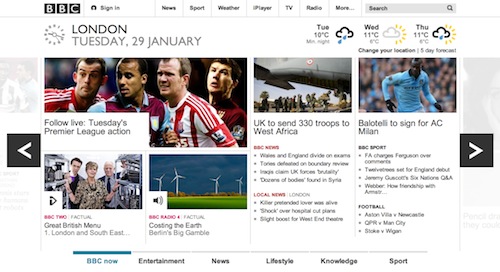
bbc.co.uk, The BBC Homepage is full of impact.
Communication
A website must convey a message. Your content and copy and what you want to say is important. Good readable copy is the aim. User’s tend to skim websites and only read 20% of your content in order to get your message. Therefore you want to limit your copy and get your message across succinctly.
Visual communication - color, typography, branding, layout, icons
User interaction - links, sharing, audio/video
Content copy - Titles/headers, icons, images
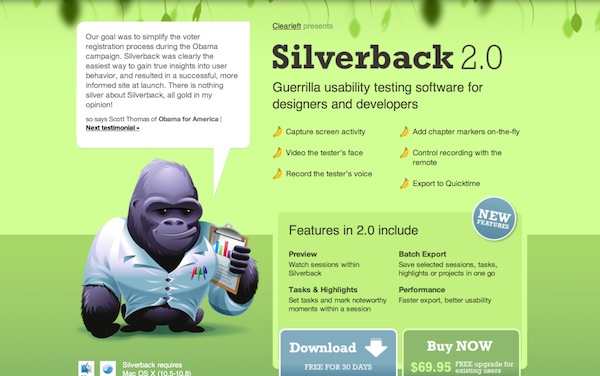
silverbackapp.com, Clear, concise communicative website.
Narrative
This leads onto narrative. The point of a website is to display content. Therefore your site must lead the user to discover a narrative and whatever message you are trying to convey. This narrative is dictated by site architecture as well as design and layout.
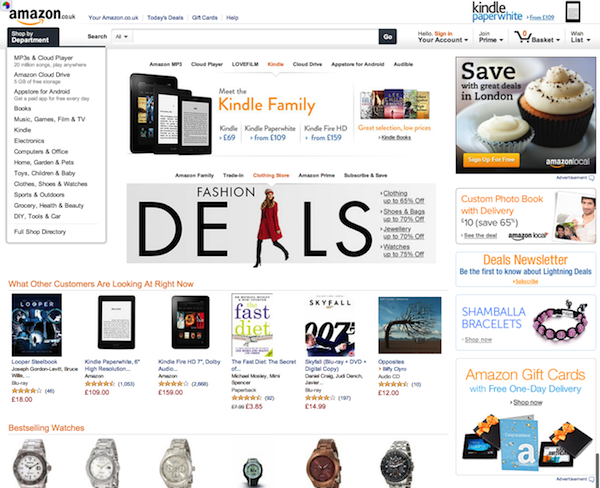
amazon.co.uk, A website driven by narrative and ensuring users explore their many faceted areas of the site.
Users of the web medium
Jon Tan in his excellent article (source below) about narrative architecture for the web, highlighted four different types of web users:
1) Activist
2) Reflector
3) Theorist
4) Pragmatist
Activists like to continue exploring until their need is sated. This means that a website must have good navigation and many links.
Reflectors like to reflect and then decide. An example of this would be ‘Save to shopping basket’.
Theorists like logic and details of what they will get from a site.
Pragmatist are quick and make quick assumptions.
Most users are a mixture of two of these types. As architects of web sites we must build to encourage the particular audience of your site to use explore.
Conclusion
The web as a medium has led to it’s own solution in solving communication of content in an adapting environment. It has branched out of becoming fixed in the print medium. We find that design, content, layout, user experience, device and the type of user all contribute to the growth of the web as a medium. All these aspects are becoming more fine-tuned by the fact that the web has become so integrated into our everyday lifestyle.
Sources
Clear and effective communication in web design - Smashing Magazine
Effective communication for the web - Six Revisions